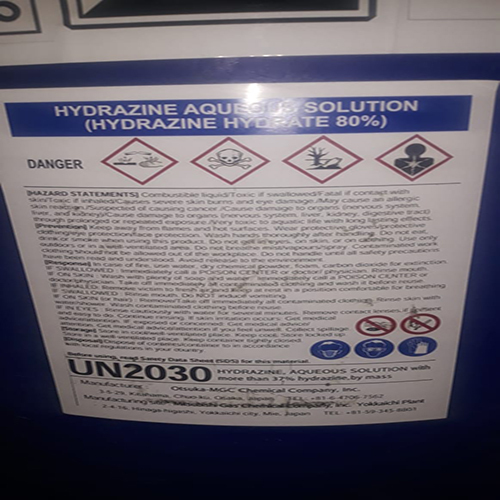
About HYDRAZINE HYDRATE
A strong reducing agent used in water treatment, pharmaceuticals, agrochemicals, and polymerization. It acts as an oxygen scavenger in boilers, a blowing agent in plastics, and a key intermediate in pharmaceutical and pesticide synthesis.
Versatile Industrial ApplicationsHydrazine Hydrate stands out for its multifaceted uses in industry, from purifying metals in mining to serving as a crucial corrosion inhibitor in power plants. Its utility extends to laboratory reagents and as a polymerization catalyst, offering value in manufacturing surfactants, detergents, and plasticizers. Its adaptability across sectors makes it a preferred chemical for manufacturers, exporters, and distributors.
Safety and Handling PrecautionsDue to its poisonous nature, Hydrazine Hydrate requires strict safety measures. Handling should only be performed in well-ventilated areas using proper personal protective equipment. Storage in tightly-sealed containers away from incompatible substances is essential to minimize exposure and maintain chemical stability.
FAQs of HYDRAZINE HYDRATE:
Q: How is Hydrazine Hydrate typically used in industrial settings?
A: Hydrazine Hydrate is mainly used as a reducing agent for purifying precious metals, as a corrosion inhibitor in industrial boilers, and as a laboratory reagent in chemical synthesis. It also functions as a catalyst in polymerization processes and in the manufacture of surfactants and detergents.
Q: What precautions are necessary when handling Hydrazine Hydrate?
A: Due to its toxic properties, Hydrazine Hydrate must be handled with care, utilizing chemical-resistant gloves, safety goggles, and well-ventilated environments. Direct contact and inhalation should be strictly avoided to prevent health hazards.
Q: When is Hydrazine Hydrate most beneficial in laboratory applications?
A: Hydrazine Hydrate is particularly valuable as a reagent in fine chemicals synthesis, where it introduces reactive hydrazine groups under controlled laboratory conditions. Its reducing abilities and compatibility with other chemicals make it useful for specific synthetic pathways.
Q: Where is Hydrazine Hydrate supplied from in Taiwan?
A: In Taiwan, Hydrazine Hydrate is distributed, exported, imported, and manufactured by various chemical suppliers. Businesses and laboratories typically source it from accredited chemical distributors to ensure product quality and compliance with safety regulations.
Q: What is the process for using Hydrazine Hydrate as a corrosion inhibitor?
A: In boiler and power plant operations, Hydrazine Hydrate is added directly to the water system. It reacts with oxygen in water to prevent oxidative damage to metal components, thereby extending the lifespan of the equipment.
Q: What are the benefits of using Hydrazine Hydrate in precious metal purification?
A: When used as a reducing agent, Hydrazine Hydrate effectively separates and purifies precious metals in mining. This process increases yield and reduces contaminants, making extraction more efficient.

 Send Inquiry



 Send Inquiry

 Send Inquiry


