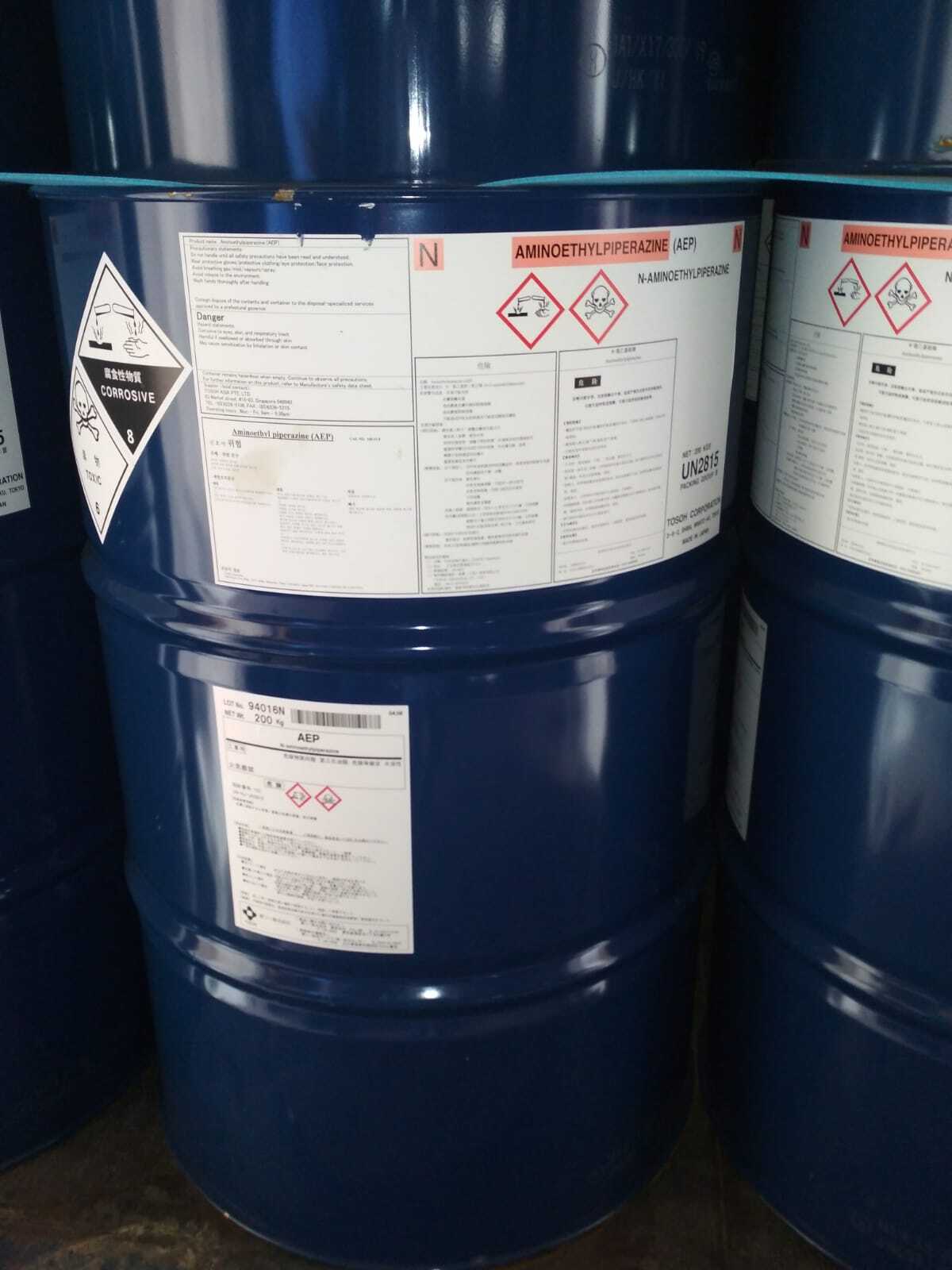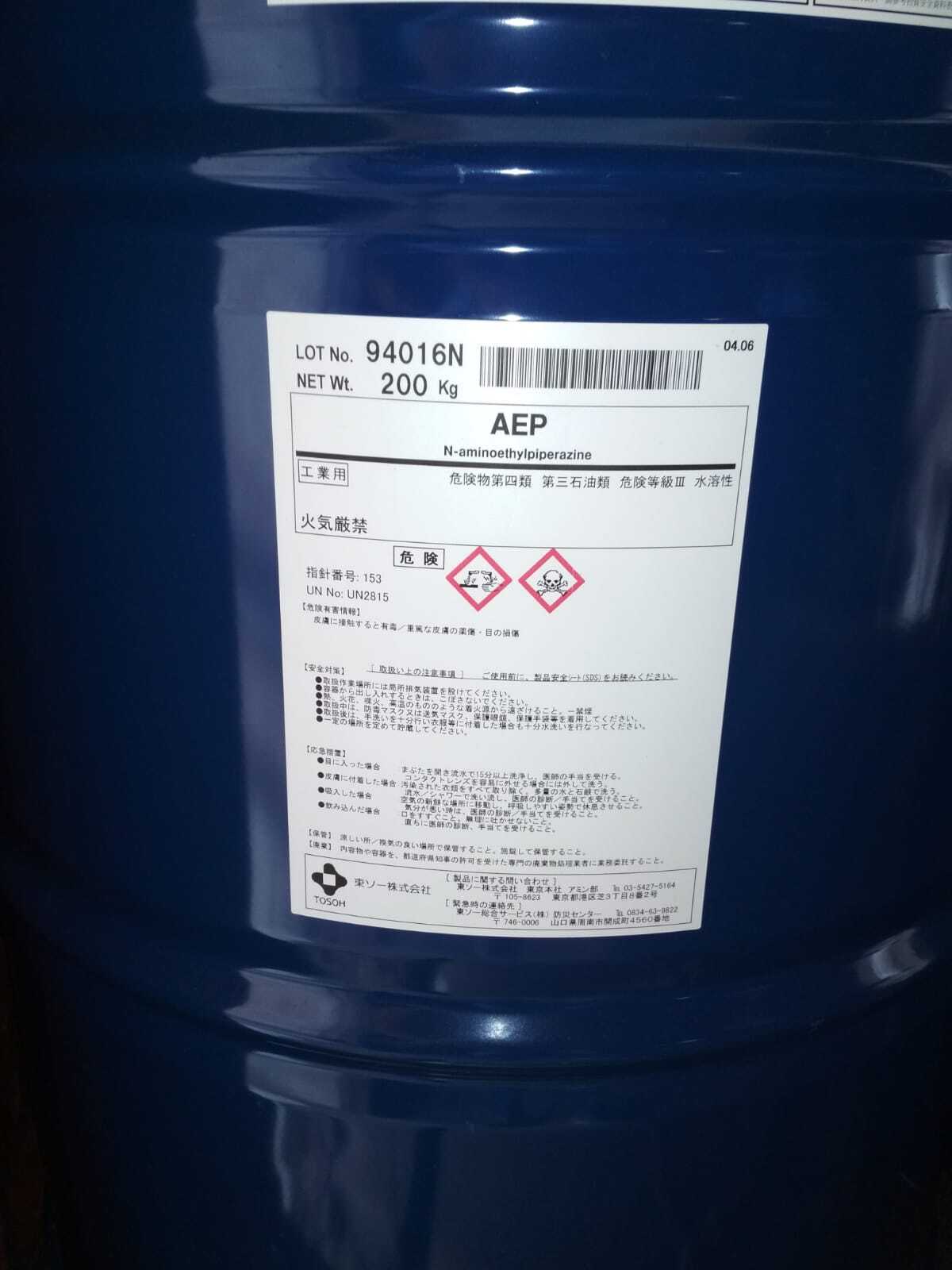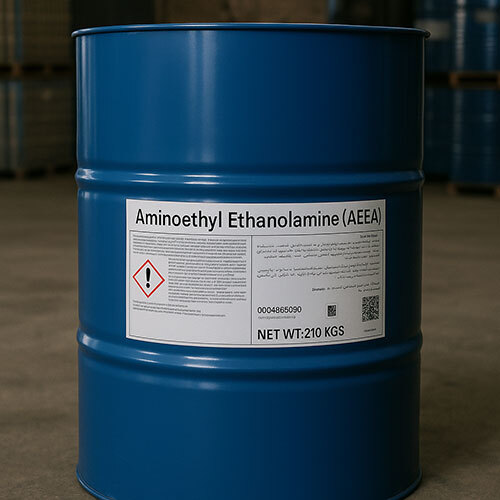
AMINOETHYLPIPERAZINE (AEP)

AMINOETHYLPIPERAZINE (AEP)

MOQ : 200 Kilograms

AMINOETHYLPIPERAZINE (AEP) Specification

  • Density
  • 984 kg/m Kilogram per cubic meter (kg/m3)
  • Boiling point
  • 222 C
  • Melting Point
  • 19 C
  • Storage
  • Dry Place
  • Other Names
  • 2-piperazin-1-ylethylamine
  • Form
  • Liquid
  • HS Code
  • 29335990
  • Molecular Weight
  • 129.20 g/mol Grams (g)
  • Molecular Formula
  • C6H15N3
  • Chemical Name
  • Aminoethyl piperazine
  • CAS No
  • 140-31-8
  • EINECS No
  • 205-411-0
  • Grade
  • Industrial Grade
  • Usage
  • Asphalt additives Mineral processing aids Corrosion inhibitors Epoxy curing agents Polyamide resins Urethane chemicals
 

AMINOETHYLPIPERAZINE (AEP) Trade Information

  • Minimum Order Quantity
  • 200 Kilograms
  • Supply Ability
  • 20000 Kilograms Per Week
  • Delivery Time
  • 10 Days
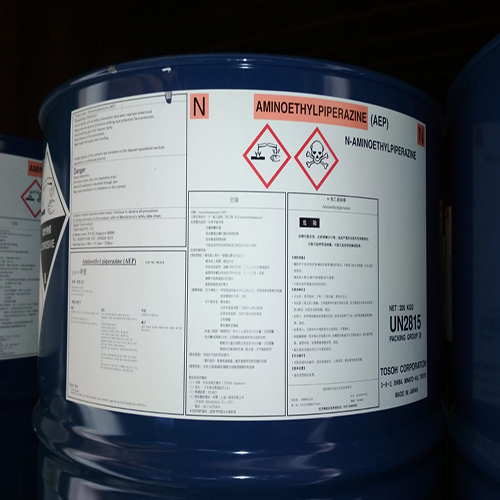
  • Packaging Details
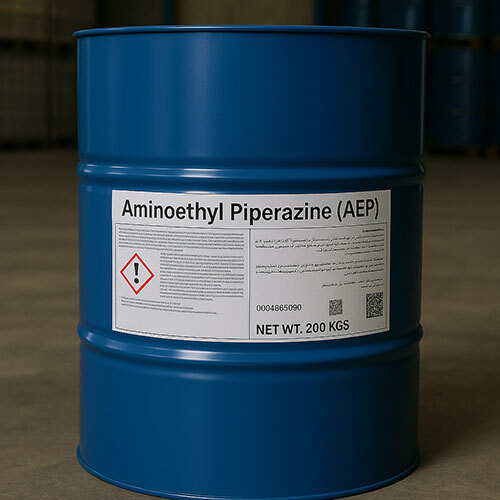
  • 200kg sealed MS DRUM
 

About AMINOETHYLPIPERAZINE (AEP)

Aminoethylpiperazineis a derivative of piperazine. This ethyleneamine contains three nitrogen atoms; one primary, one secondary and one tertiary.


AEP is a colorless liquid with a broad liquidrange. This makes it a suitable raw material for a largevariety of applications including corrosion inhibitors,urethane catalysts and epoxy hardeners


Characteristic Unit Specification Methods of Analysis

Appearance - clear liquid 200

Assay w% Min 98.0 564

Water w% max 0.5 305

Color Hazen max 50 201


Versatile Industrial Applications

Aminoethylpiperazine (AEP) plays a key role in several industries due to its multi-functional properties. It serves as a crucial component in asphalt additives, assists in mineral processing, and acts as an effective corrosion inhibitor. Additionally, it supports the production of epoxy curing agents, polyamide resins, and urethane chemicals, making it an asset for manufacturers seeking high-performance solutions.


Proper Storage and Handling

Maintaining the efficacy and safety of AEP requires storage in dry places away from direct sunlight and moisture. Its liquid form at room temperature ensures ease in handling and dosing, but adequate precautions should be taken to avoid contact with incompatible substances. Following recommended storage practices prolongs shelf life and preserves chemical stability.

FAQs of AMINOETHYLPIPERAZINE (AEP):


Q: What are the primary uses of Aminoethylpiperazine (AEP) in industry?

A: AEP is utilized in a range of applications, including asphalt additives, mineral processing aids, corrosion inhibitors, epoxy curing agents, polyamide resins, and urethane chemicals, thanks to its chemical versatility and reactivity.

Q: How should Aminoethylpiperazine be stored to ensure optimal performance?

A: For maximum stability and to maintain its chemical properties, AEP must be stored in a dry place, away from moisture and direct sunlight. Proper storage prevents unwanted reactions and degradation.

Q: Where does Aminoethylpiperazine find its greatest benefit?

A: AEP delivers significant benefits in improving the durability of asphalt, enhancing corrosion resistance, and optimizing epoxy and resin polymerization processes. Industries that focus on infrastructure, protective coatings, and chemical manufacturing gain the most from its usage.

Q: What is the recommended process for handling and dosing AEP in industrial applications?

A: Given its liquid form and moderate melting point, AEP lends itself to easy pumping, mixing, and incorporation into formulations. Users should employ standard chemical handling procedures and utilize appropriate PPE to ensure safety.

Q: When should industries consider using AEP over other amine compounds?

A: Industries should opt for AEP when they require a compound with a balanced blend of reactivity and versatility across multiple usessuch as for curing agents, corrosion prevention, and adhesion improvement in resin systems.

Q: Why is Aminoethylpiperazine favored in epoxy curing and polyamide resin production?

A: AEPs unique molecular structure enables it to act efficiently as a curing agent, promoting strong crosslinking and enhancing thermal and mechanical properties in epoxy and polyamide products.

Tell us about your requirement
product

Price:

Quantity
Select Unit

  • 50
  • 100
  • 200
  • 250
  • 500
  • 1000+
Additional detail
Mobile number

Email

More Products in Amines Category

MONOETHANOLAMINE (MEA)

MONOETHANOLAMINE (MEA)

Minimum Order Quantity : 200 Kilograms

Form : Liquid

Usage : Cleaning industry ,Corrosion Inhibitors, Pharmaceuticals, Textile Auxiliaries, Cosmetics and Wood Chemicals, Cement Grinding Aids

Grade : Industrial Grade

Density : 1.01 g/cm Gram per cubic meter (g/m3)

EINECS No : 2054833

DIETHANOLAMINE (DEA)

DIETHANOLAMINE (DEA)

Minimum Order Quantity : 200 Kilograms

Form : Liquid

Usage : Detergents ,Cleaners,Concrete admixtures,Urethane foam catalysts, Pharmaceuticals,Personal care products,

Grade : Industrial Grade

Density : 1.09 g/cm Gram per cubic meter (g/m3)

EINECS No : 2038680

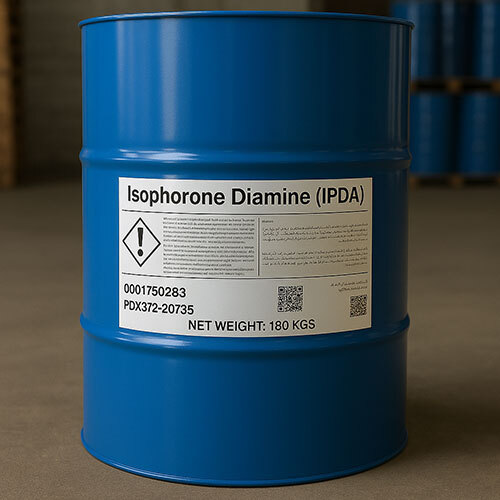
ISOPHORONEDIAMINE (IPDA)

ISOPHORONEDIAMINE (IPDA)

Minimum Order Quantity : 200 Kilograms

Form : Liquid

Usage : (IPDA) is a cross linker for epoxy resins, building block for polyamides. It is used in epoxy coatings, epoxy adhesives and ...

Grade : Industrial Grade

Density : 0.923 0.924 Gram per cubic centimeter(g/cm3)

EINECS No : 2206668

TETRAETHYLENEPENTAMINE (TEPA)

TETRAETHYLENEPENTAMINE (TEPA)

Minimum Order Quantity : 200 Kilograms

Form : Liquid

Usage : asphalt additives, corrosion inhibitors, epoxy curing agents, hydrocarbon purification, lube oil and fuel additives, mineral processing, polyamide resins, surfactants, and textile adhesives.

Grade : Industrial Grade

Density : 0.990 g/cm3

EINECS No : 2039862


Back to top