About डाà¤à¤®à¤¿à¤¥à¤¾à¤à¤² फà¥à¤°à¥à¤®à¤¾à¤®à¤¾à¤à¤¡ (DMF)
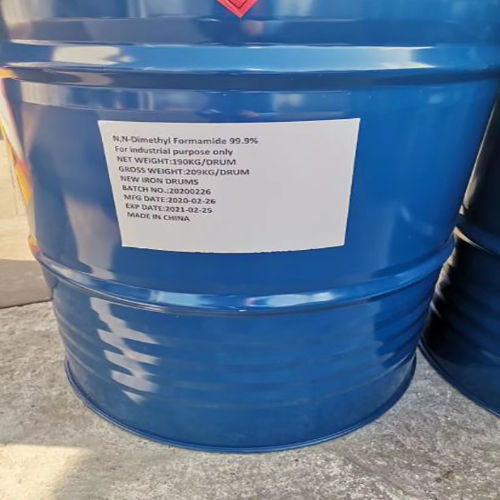
A powerful organic solvent used in synthetic fibers, resins, pharmaceuticals, and chemical processing. It offers excellent solubility for polymers, dyes, and agrochemicals, making it essential in coatings, adhesives, and electronics manufacturing.
Versatile Industrial ApplicationsDimethyl Formamide (DMF) is prized in the chemical industry for its adaptability, excelling as a solvent and reagent. It is commonly used for extracting chlorophyll from plant tissues and as a critical component in organic synthesis, making it an essential product for manufacturers, exporters, and suppliers across the globe.
Physical and Chemical AttributesDMF is characterized by its clear liquid form, substantial density of 944 kg/m, and molecular weight of 73.09 g/mol. These physical and chemical properties contribute to its efficacy in diverse roles, such as dehydration, reduction, and catalysis, enhancing its industrial utility.
Reliable Sourcing and SupplyMajor distributors and suppliers based in China offer DMF for industrial and laboratory applications. Their commitment to quality control and compliance ensures that clients receive a product that meets strict international standards, catering to the needs of industries worldwide.
FAQs of DIMETHYL FORMAMIDE (DMF):
Q: How is Dimethyl Formamide (DMF) utilized in industrial applications?
A: DMF is widely used in industries as a solvent for chemical reactions, in the extraction of chlorophyll from plant tissues, and as a reagent in organic synthesis. Its multifaceted roles include acting as a solvent, dehydrating agent, reducing agent, and catalyst, providing valuable support for various industrial processes.
Q: What are the key physical properties of DMF that contribute to its functionality?
A: Dimethyl Formamide is a liquid with a density of 944 kg/m and a molecular weight of 73.09 g/mol. These properties, along with its molecular structure (C3H7NO), make it a highly effective solvent and versatile agent in chemical processes.
Q: When should DMF be employed as a dehydrating agent or catalyst in synthesis?
A: DMF is particularly effective as a dehydrating agent or catalyst during organic synthesis reactions that require water removal or catalytic support for enhanced chemical transformations. Its high polarity allows it to facilitate these reactions efficiently.
Q: Where can DMF be sourced for industrial use?
A: DMF can be sourced from verified distributors, exporters, importers, and manufacturers in China. Suppliers from this region are known to provide industrial-grade DMF in compliance with international quality standards, ensuring dependable supply chains for buyers worldwide.
Q: What is the process for using DMF in the isolation of chlorophyll from plants?
A: In the isolation of chlorophyll, DMF serves as a solvent to extract chlorophyll molecules from plant tissues. The process involves immersing the plant samples in DMF, which dissolves the chlorophyll, enabling its separation and subsequent analysis or application.
Q: What benefits does DMF offer compared to other solvents in organic synthesis?
A: DMFs high polarity, low volatility, and exceptional solvency power grant it an advantage over many other solvents. Its capacity to dissolve a broad range of organic and inorganic compounds enhances reaction efficiency and product yield, making it a preferred choice for chemists.