About à¤à¤à¤¸à¥à¤«à¥à¤²à¤¿à¤ à¤à¤¸à¤¿à¤¡
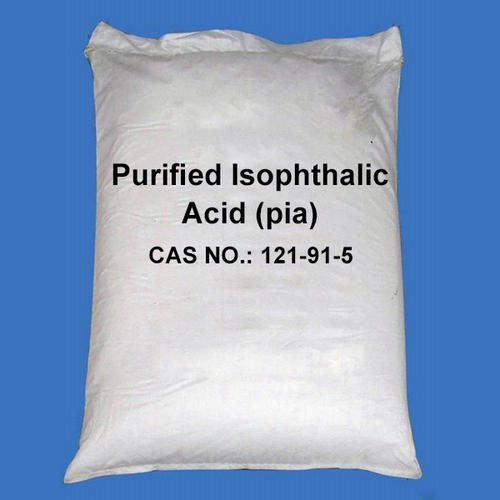
A high-purity dicarboxylic acid widely used in PET resins, alkyd coatings, and high-performance polymers. It improves chemical resistance, mechanical strength, and thermal stability in applications like fiberglass-reinforced plastics, powder coatings, and adhesives.
Versatile Industrial ApplicationsIsophthalic Acid is primarily used in the creation of metal coordination polymers, benefiting diverse industrial processes. Its role as a precursor in the fabrication of nanocomposites, including isophthalic acid-zirconium(IV), enables the production of crystalline tetragonal zirconia (ZrO2). These materials are crucial in sectors like advanced ceramics and catalysis.
Distinct Physical PropertiesThis compound appears as a white crystalline powder, with a notable melting point of 341-343C and density of 1.53 g/cm3. Its molecular structure (C8H6O4) is distinguished from its isomers, phthalic and terephthalic acid, ensuring it meets specific industrial requirements. The product is recognized for its stability and safety, as it is non-poisonous.
FAQs of ISOPHTHALIC ACID:
Q: What are the main uses of Isophthalic Acid in industry?
A: Isophthalic Acid is primarily used in the synthesis of metal coordination polymers and as a precursor in forming isophthalic acid-zirconium(IV) nanocomposites. These nanocomposites are further processed to produce crystalline tetragonal ZrO2, essential in ceramics and catalysis.
Q: How is Isophthalic Acid typically processed for advanced materials?
A: Isophthalic Acid undergoes hydrothermal and sonochemical methods to create metal coordination polymers. When combined with zirconium(IV), it forms nanocomposites that are thermally decomposed to yield crystalline tetragonal ZrO2.
Q: What benefits does Isophthalic Acid offer compared to its isomers?
A: Compared to its isomers, phthalic and terephthalic acid, Isophthalic Acid has unique reactivity and stability, making it especially suitable for producing specialty polymers and advanced ceramic materials.
Q: Where can Isophthalic Acid be sourced within India?
A: Isophthalic Acid is readily available from numerous distributors, exporters, importers, manufacturers, and suppliers throughout India, catering to the countrys industrial and research needs.
Q: What are the safety considerations when handling Isophthalic Acid?
A: Isophthalic Acid is classified as non-poisonous. However, standard industrial safety protocols, such as using protective equipment and ensuring proper ventilation, should always be observed when handling the powdered material.
Q: When should Isophthalic Acid be chosen for polymer production?
A: Select Isophthalic Acid for polymer applications when specific thermal stability, crystallinity, or compatibility properties are required, particularly for high-performance materials or nanocomposite precursors.