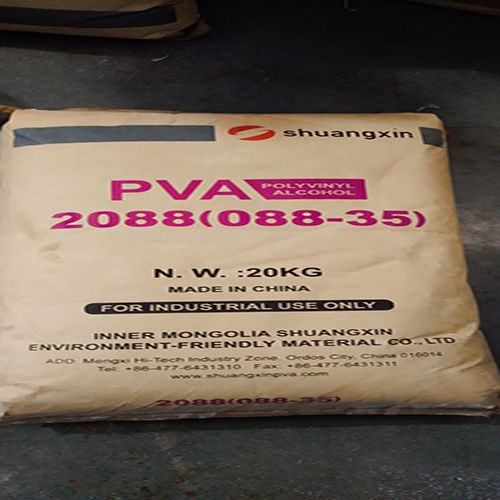
About POLYVINYL ALCOHOL (PVA)
Polyvinyl alcohol (PVA) is a non-polluting water-soluble polymer, usually white or slight yellow floccule, flake, granular or powder solid. Its performance is between plastic and rubber. It has good adhesion, film-forming ability, insulation, oil resistance, abrasion resistance and gas barrier property, etc.Versatile Applications Across IndustriesPolyvinyl Alcohols flexible characteristics make it essential in a range of fields. It serves as a key adhesive in textile and printing industries, enhances concrete durability through fiber reinforcement, and functions as a lubricant in medical products like eye drops. Its adaptability stems from its water solubility, film-forming ability, and chemical resistance.
Stable and Safe CompositionComposed of polyvinyl alcohol [(C2H4O)x], PVA is non-poisonous and safe for industrial use. Its physical form as a powder or granule ensures easy handling and consistent application, while its impressive melting point and density uphold its structural properties under various conditions.
FAQs of POLYVINYL ALCOHOL (PVA):
Q: How is Polyvinyl Alcohol (PVA) typically used in industrial applications?
A: PVA is used as an adhesive in the printing and textile industries, as fiber reinforcement in concrete, for reducing residue during fabric sizing and weaving, and as a lubricant in medical products such as eye drops. Its versatility arises from its water-solubility, adhesive properties, and tensile strength.
Q: What benefits does PVA provide when incorporated into concrete?
A: When used as a fiber reinforcement in concrete, PVA improves the materials tensile strength and durability, reducing the formation of microcracks and enhancing the long-term structural integrity of construction projects.
Q: Where should Polyvinyl Alcohol powder be stored for maximum shelf life?
A: PVA powder should be stored at room temperature in a dry, sealed container, away from direct moisture and humidity, to ensure its stability and maintain its physical and chemical properties.
Q: What is the process for dissolving PVA in water for industrial use?
A: To dissolve PVA powder, gradually add it to warm water while continuously stirring. The waters temperature should typically be between 80C and 90C to allow for efficient dissolution and to form a clear, homogeneous solution for use as an adhesive or binder.
Q: Is Polyvinyl Alcohol (PVA) safe to handle and use?
A: Yes, PVA is classified as non-poisonous and safe for standard industrial applications. However, it is recommended to use personal protective equipment such as gloves and masks when handling the powder to prevent inhalation or skin irritation.
Q: What are some specific benefits of using PVA as a film-forming and adhesive agent?
A: PVAs strong film-forming and adhesive qualities provide reliable bonding in materials, making it especially valued in the printing and textile industries. It ensures clean application, easy residue removal, and durable adhesion.

 Send Inquiry



 Send Inquiry

 Send Inquiry


